
Overview

When you share a data connector with your team, something powerful happens: Julius learns from everyone’s interactions. This creates a network effect where more users means faster, more accurate learning for the entire team.

How Network Effects Work

Every time a team member interacts with a shared data connector, they contribute to the collective knowledge base. The Learning Sub Agent aggregates insights from all conversations, building a comprehensive understanding of your data that benefits everyone. Shared Connection Learning Diagram
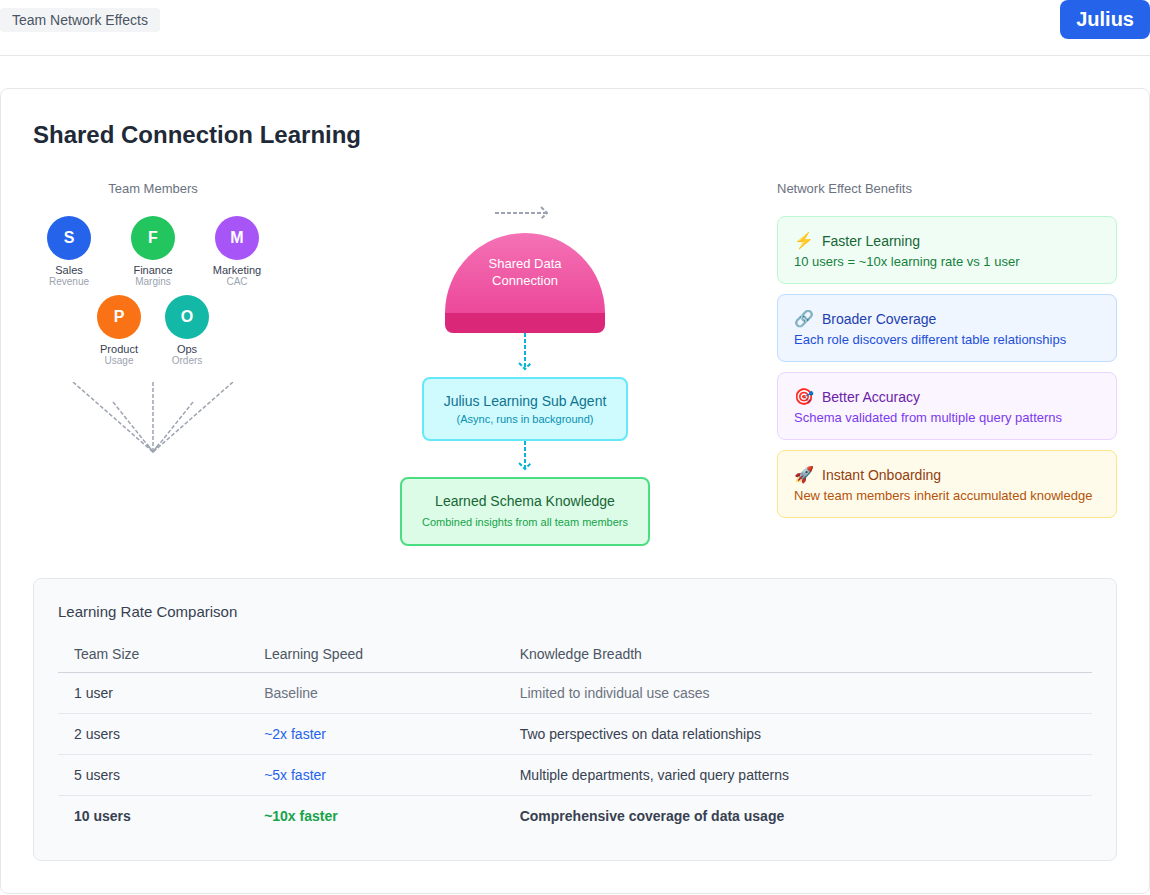
The Multiplier Effect

Consider the difference between individual and team usage:
Team SizeLearning RateKnowledge Breadth
1 userBaselineLimited to individual use cases
2 users~2x fasterTwo perspectives on data relationships
5 users~5x fasterMultiple departments, varied queries
10 users~10x fasterComprehensive coverage of data usage
With 10 people using a shared connector instead of 2, Julius isn’t just learning 5x more—it’s learning qualitatively better. Different team members ask different types of questions, explore different table relationships, and provide different business context.

What This Means for Your Team

Faster Accuracy: A sales team member who frequently joins orders with customers teaches Julius relationships that benefit the finance team member analyzing the same data. Broader Context: Marketing’s understanding of campaign tables combines with engineering’s knowledge of event tracking to create a more complete picture. Reduced Onboarding: New team members benefit from the accumulated knowledge of everyone who came before them. Day one with Julius feels like day 100.

Practical Implications

Share connectors strategically: The more people using a single connector instance, the smarter it becomes. Consider sharing connectors across teams that use the same underlying data. Encourage diverse queries: Different question types from different roles accelerate learning. A connector used only for one type of report learns slower than one used for varied analysis. Onboard as a team: When rolling out Julius, having multiple team members start using the same connector simultaneously creates rapid initial learning.

Privacy Note

While Julius learns from all team interactions with a shared connector, it only learns about data structure and relationships—never the actual data values. Each team member’s queries and results remain private; only the schema knowledge is shared.